
Digital Entrepreneurship & Innovation Ecosystem Development in Bangladesh: An Overview
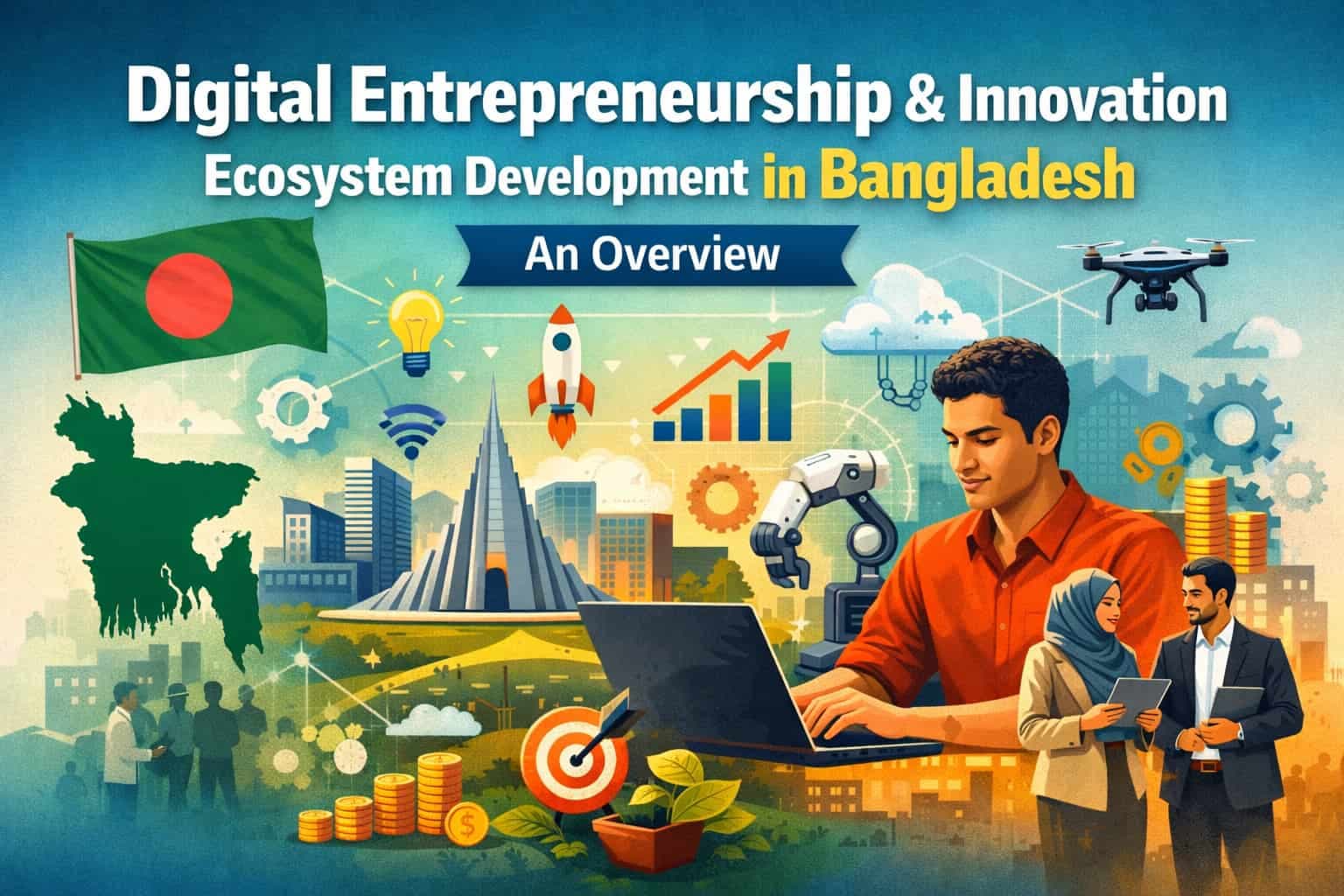
Bangladesh is undergoing a significant transformation driven by digital technologies, youthful demographics, and a rapidly expanding startup culture. Over the past decade, the country has moved beyond being only a consumer of technology to becoming an emerging hub for digital innovation and entrepreneurship in South Asia. This shift is supported by government initiatives, private sector investment, academic involvement, and the growing ambition of young entrepreneurs who are building technology-based solutions for both local and global markets.
At the heart of this transformation lies the development of a structured digital entrepreneurship and innovation ecosystem — an environment where startups, investors, mentors, universities, government agencies, and technology infrastructure work together to nurture ideas and turn them into scalable businesses.
The Rise of Digital Entrepreneurship in Bangladesh
Digital entrepreneurship in Bangladesh has accelerated with the expansion of internet access, mobile financial services, cloud computing, and affordable smart devices. Today, millions of people are connected online, creating new markets for e-commerce, fintech, health tech, edtech, agritech, and software services.
Young entrepreneurs are increasingly choosing technology-driven business models because they:
- Require lower initial capital compared to traditional industries
- Can scale quickly using digital platforms
- Have access to global customers and tools
- Benefit from remote work and outsourcing opportunities
The success of local startups and the presence of international technology companies have also inspired a new generation to pursue innovation-led ventures rather than conventional career paths.
Key Pillars of the Innovation Ecosystem
A strong digital entrepreneurship ecosystem is built on several interconnected pillars:
Policy and Government Support
Government policies play a crucial role in creating a favorable environment for startups. Supportive regulations, tax incentives, digital infrastructure, and national digital transformation strategies help reduce barriers for new businesses. Bangladesh has been investing in:
- ICT infrastructure and nationwide connectivity
- Startup-friendly policies and funding mechanisms
- Innovation hubs and technology parks
- Skills development programs aligned with Fourth Industrial Revolution (4IR) technologies
These initiatives aim to create an enabling environment where innovation can thrive.
Education and Skill Development
Universities and training institutions are central to building a pipeline of skilled entrepreneurs and technologists. Programs focused on:
- Software development
- Artificial intelligence and data science
- Cybersecurity
- Digital marketing
- Product design and UX
- Business incubation and entrepreneurship
are helping students transform ideas into market-ready solutions. University innovation hubs and research centers also encourage collaboration between academia and industry.
Startup Incubation and Acceleration
Incubators and accelerators provide early-stage startups with:
- Mentorship from industry experts
- Business development support
- Access to investors
- Workspace and technical resources
- Market validation and pilot opportunities
These programs reduce the risk for first-time founders and significantly increase the survival and growth rate of startups.
Access to Finance and Investment
Capital is one of the most critical components of any innovation ecosystem. In Bangladesh, funding sources for digital entrepreneurs now include:
- Angel investors
- Venture capital firms
- Corporate venture arms
- Government-backed funds
- International development partners
Alongside funding, financial literacy and investment readiness programs help founders understand valuation, compliance, and long-term growth planning.
Infrastructure and Technology Parks
Modern digital businesses require reliable internet, cloud services, data centers, co-working spaces, and research facilities. Technology parks and innovation centers provide:
- High-speed connectivity
- Office and laboratory spaces
- Collaboration zones
- Access to testing and prototyping facilities
Such infrastructure enables startups to operate efficiently and collaborate with peers, mentors, and investors.
Role of Public–Private Collaboration
One of the most important drivers of ecosystem development is collaboration between government, private sector, academia, and development partners. Public–private partnerships help:
- Align education with industry needs
- Bridge funding gaps for early-stage ventures
- Facilitate technology transfer
- Create market access for innovative solutions
When policy makers, corporations, universities, and startups work together, innovation becomes more sustainable and impactful.
Inclusion and Diversity in Digital Entrepreneurship
A modern innovation ecosystem must be inclusive. In Bangladesh, special focus is being given to:
- Women entrepreneurs
- Youth from underrepresented regions
- Persons with disabilities
- Social and impact-driven startups
Targeted training, mentorship, and funding programs help ensure that the benefits of digital transformation are shared across society and that diverse perspectives contribute to innovation.
Linking National Initiatives with the Broader Ecosystem
Several national-level programs and projects are working to strengthen the overall digital entrepreneurship framework by connecting training, infrastructure, investment, and policy support into one integrated system. These initiatives aim to:
- Develop a pipeline from skills to startups
- Connect universities with industry and investors
- Support the commercialization of research and innovation
- Promote Bangladesh as a regional innovation hub
For example, the DEIED (Digital Entrepreneurship & Innovation Ecosystem Development) initiative under the Bangladesh Hi-Tech Park Authority plays a key role in coordinating many of these efforts by focusing on startup acceleration, innovation infrastructure, skill development, and ecosystem building. Such initiatives act as anchors that bring together multiple stakeholders and align them toward a common national vision.
Opportunities for the Future
Bangladesh's digital entrepreneurship ecosystem holds enormous potential in areas such as:
- Fintech and digital financial inclusion
- Health technology and telemedicine
- Agri-tech and smart farming
- E-commerce and logistics
- AI-driven services and automation
- Software export and global freelancing platforms
With a large, tech-savvy youth population and increasing international interest, the country is well-positioned to become a regional leader in digital innovation.
Challenges to Address
Despite rapid progress, some challenges remain:
- Limited access to early-stage funding for deep-tech startups
- Need for stronger industry–academia collaboration
- Regulatory adaptation for emerging technologies
- Talent retention and brain drain
- Scaling local startups to global markets
Addressing these issues requires continuous policy refinement, private sector engagement, and long-term ecosystem planning.
Conclusion
The development of a robust digital entrepreneurship & innovation ecosystem is essential for Bangladesh's transition to a knowledge-based economy. By strengthening skills, infrastructure, funding, policy support, and collaboration, the country is creating an environment where innovative ideas can grow into sustainable businesses.
As government agencies, universities, investors, and entrepreneurs work together, Bangladesh is steadily building a foundation that not only supports startups but also drives national competitiveness, job creation, and inclusive economic growth. Initiatives such as DEIED and similar ecosystem-building programs are helping to align these efforts, ensuring that digital entrepreneurship becomes a powerful engine for the country's future.